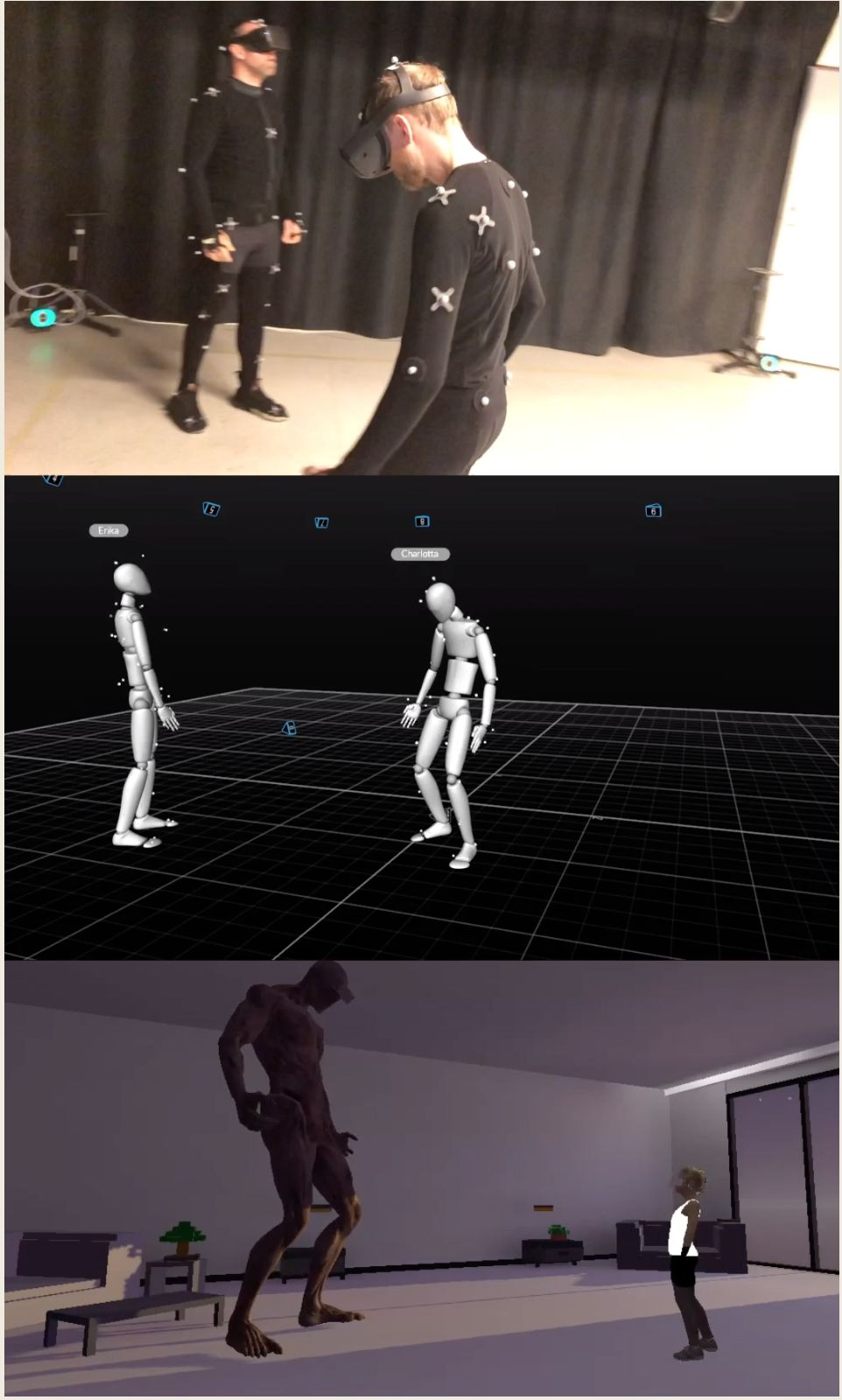
Motion capture is a well-established way to record a performance and a strange way to have to give one. The actor works in an empty room in a tight suit, against an imaginary set and often an imaginary co-actor: a marker on a stick standing in for a character who will, in the finished animation, be twice their height. All of the work of picturing that falls on the performer, and it shows up in the take.
My master's thesis at KTH asked whether virtual reality could give some of it back. The system combined VR headsets with the motion capture rig, so that two actors shared one virtual environment and saw each other as their characters, at their characters' scale, while the capture ran.
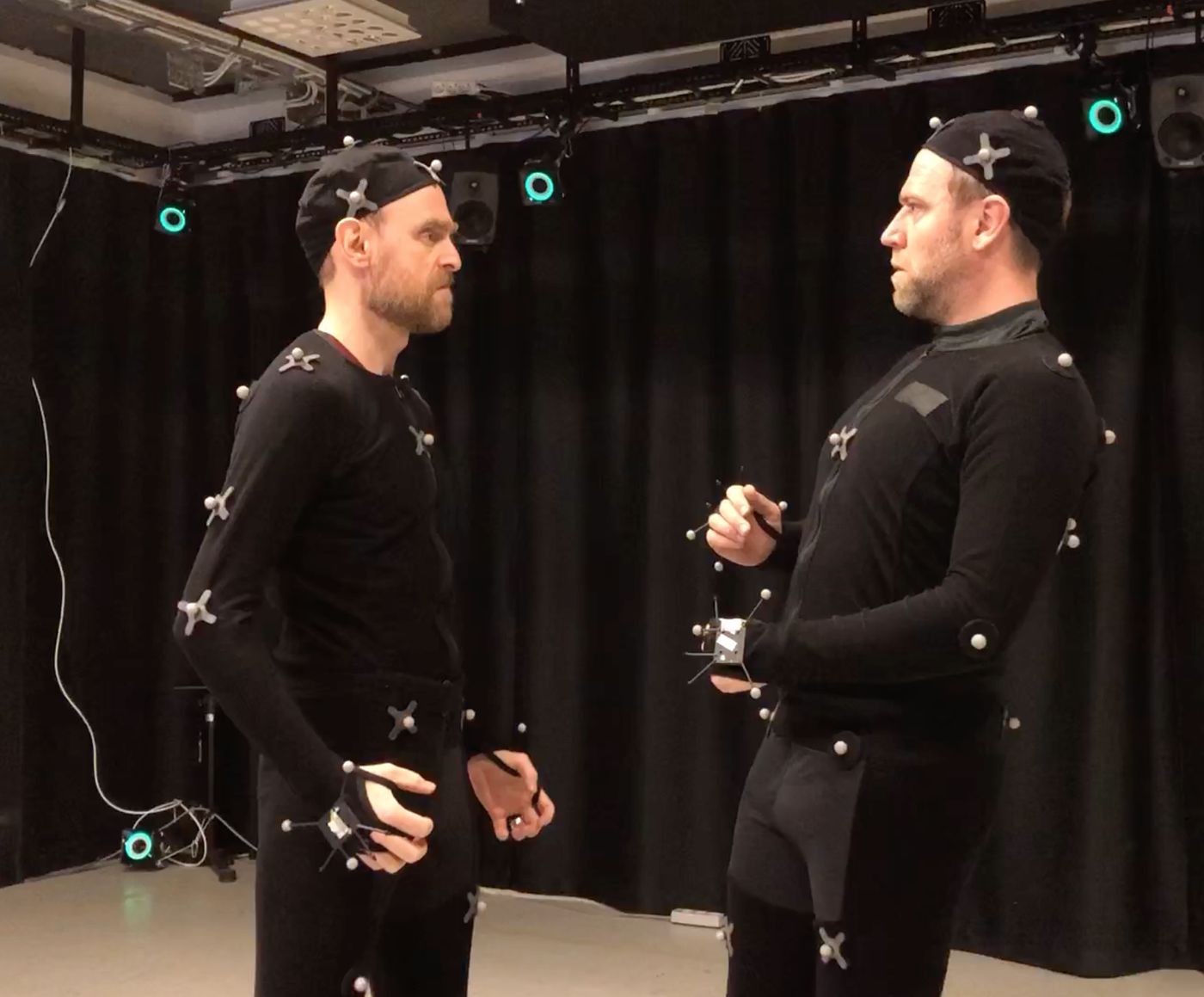
The evaluation was a within-subjects study. Two trained actors at a time performed the same scene twice, once in the traditional setup and once in VR. I measured their sense of embodiment, since the elements underneath it, presence, agency, and the connection to both their own character and their partner's, are what the empty room takes away. The data came from a post-performance questionnaire rating statements on a five-point Likert scale, and from interviews afterwards.
The VR setup improved several aspects of embodiment against the traditional one, and that changed how the scenes were played. Most participants found their character easier to portray in VR. From the interviews, the reason was consistent: they could play off an environment and a partner they were actually able to observe, rather than off a description and a marker.
After the thesis I was asked to carry the work on for publication, and it was published and presented at IEEE VR 2021.
Robin K. Kammerlander, Andre Pereira and Simon Alexanderson. Using Virtual Reality to Support Acting in Motion Capture with Differently Scaled Characters. 2021 IEEE Virtual Reality and 3D User Interfaces (VR), IEEE, 2021, pp. 402-410. doi.org/10.1109/VR50410.2021.00063
The thesis itself, Collaborative Acting in Virtual Reality, is in KTH's repository, and the record for it is in DiVA.
Reference material